How to buy wine

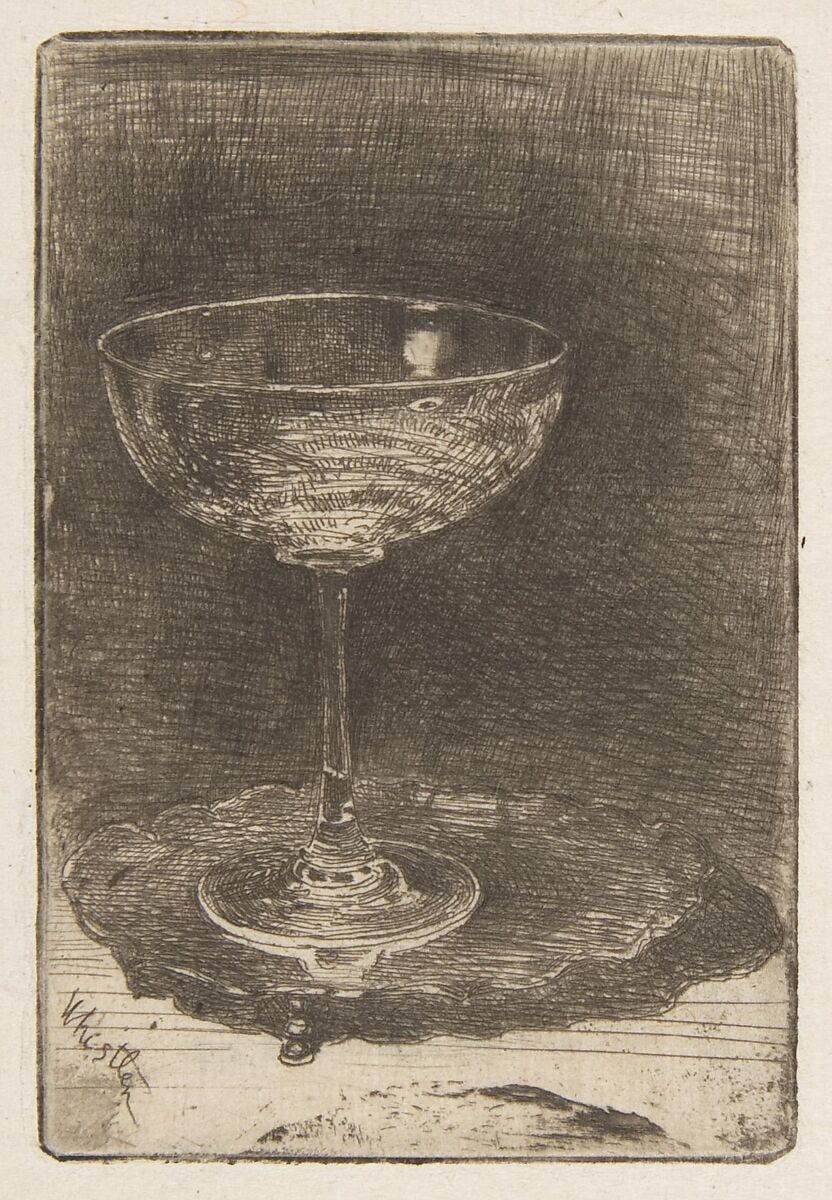
James McNeill Whistler “The wine glass”1858
I had a friend and wine buyer who liked to finish his day by pressing ‘print’ and letting the pages of the new wine list fall to the floor like leaves to the ground. Often, afterwards, we’d drink beer and talk about other stuff.
After a day of fishing with wine reps for placements, the seas needed to part between the wine-of-it-all and alcohol proper. A pint of Guiness usually served a proper filament between worlds. He started early in the day. The wine bags arrived at 9, a long and shining line that coursed throughout the day. He tasted way too quickly, often from the same glass without a rinse. He’d throw the thing back like a rip of tequila, almost careful of his tongue, and by degrees level his head with a great and spontaneous opinion fully rendered. These were really the only words we’d share about wine and, rounding up, they fell exclusively into 2 sets:
(1) {“That’s so fucking good.”}
and
(2) Nothing
I’ve seen him sail through massive tastings with hundreds of wines, all in the same tireless profluence, crossing from table to table, bobbing neck first like a toy drinking bird, daring an ounce or two of liquid to register in the maelstrom. It was kind of weird.
For me, his was a project of sentimental empiricism, more in the style of Hume than Locke. He might have poured a beer on my head if I’d proposed that to him, but more likely he’d propose one down his throat until I stopped talking. His was a stark and icy world of {good, fine, and bad (which was fine)}. He owned a great deal of knowledge about wine, producers, farming, and the business, but he held it all as far away from his taster as possible, as far away from the open, oxidizing air of conversation as his career would allow.
The acolytes of this sentimentalist friend exist on a spectrum. At the far left, I think about a buyer and friend known for carrying around an unsharpened no.2 pencil in his ear. It is an ancient style choice that predated our friendship, and one that flies boldly in the face of his buying philosophy. For him, nearly every bottle of wine (barring real industrial trash) that has made the uphill and circuitous route to the New York market can be conceptualized in 3 porous categories: {‘totally fine’, ‘super good’, ‘little funky’}. It’s a simple and elegant calculus. Wines can be one or all of these things, and their status can change throughout the course of a glass. There’s almost a Christian notion of a unity of three persons.
He proved this to me over cases and cases of the last Clos Roche Blanche vintage that our manager had holed up in the wine store’s1 basement for posterity. After particularly grueling and hungover stock shifts, he and I would pass by the mountain of Pineau D’aunis that had been in our way all day, and he’d wack it a few times with his pencil. I’d pull another bottle out. Each was totally fine, super good, and/or a little funky. He knew that good wine is a function of the people in your immediate proximity. He liked to say, pleadingly, “just drink the wine.”
To this day, he’s my favorite person to drink wine with. We never have a bad bottle because they don’t really exist. He laughs at me for chasing highfalutin, rare bottles I can’t afford, asking a question I’ve learned to ask myself periodically: “Why do you hate money?”
Buying in the style of the pencil benefits the shop or bar that wants to stock something unique or complicated — all the wines that intrepid, adventurous customers want to drink but scare other, professional wine jerks away. A salesman or small wine portfolio will always have a chance. This will also put expensive wines on a more equal playing field, which categorically disadvantages them. It is a slight disadvantage to servers and shop-workers as well who have to deal with probing wine questions. Given the current climate of conservative buying, more buyers should be like this.
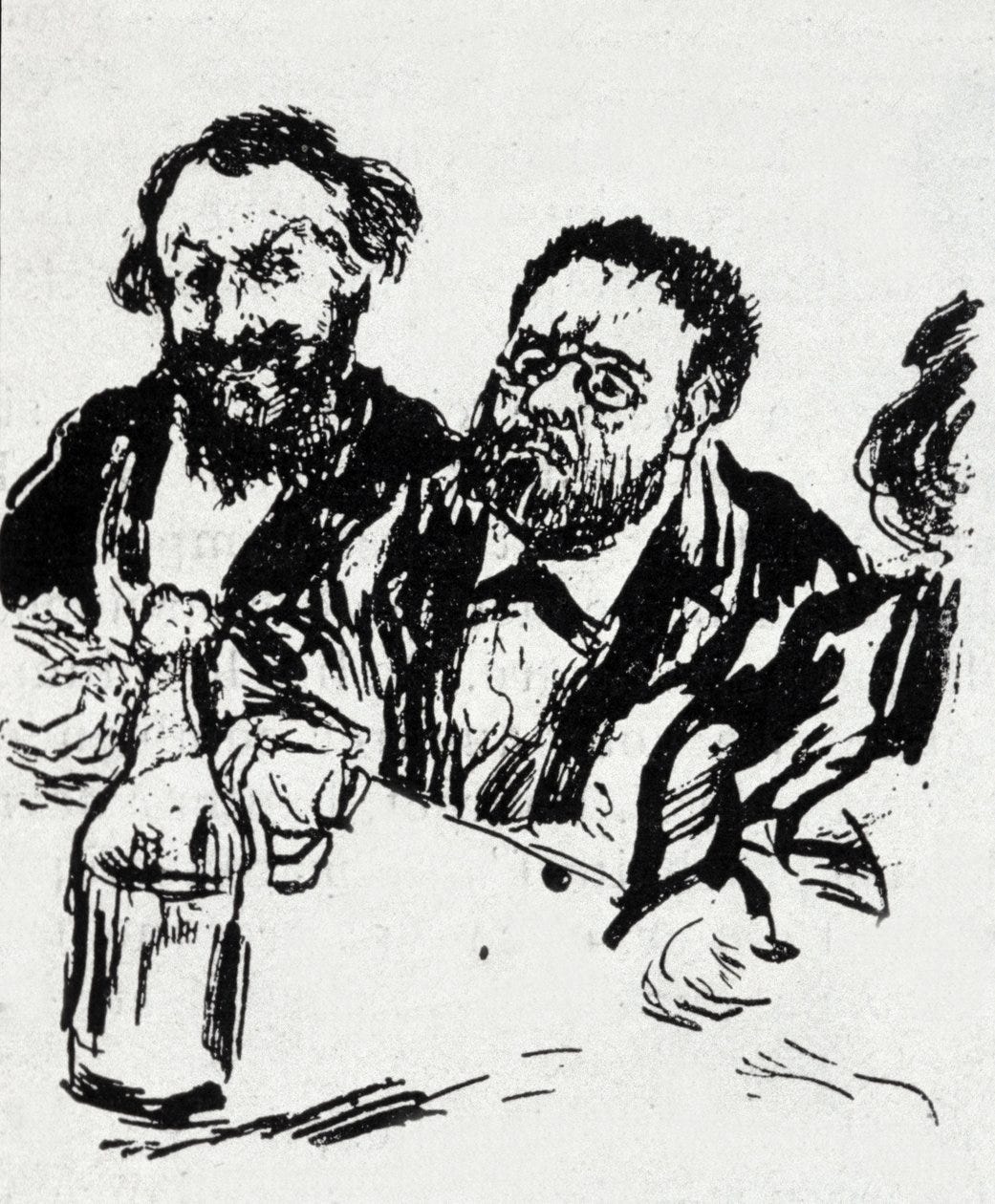
Jean Francois Raffaelli, 1870-something
At the far right of the sentimentalist spectrum we have the buyers with distinguished, hyper-sensitive pallets — the kind of king-makers, deciders, who grade on the same curve as Roger Ebert or a Roman emperor at the circus.
I’ve had friends, business partners and bosses who work like this and while they are the easiest type to critizise or tease, I often admire their self-assurance and consistency, and their harranging is often just a result of one inconsistency in their judgement against a clearly defined body of work. Their judgements’ end in a binary. You’ll hear phrases like, “It’s not doing anything for me.” I had an old boss who was a French hunter from Dijon who liked to ask, “But does it make you come?” Gross!
Still and all, their selection develops a character, a higher-order concept for a group of wines. To threaten an annoying pun, these buyers have taste. And that is a rare thing. They implore us to think normatively about wine. They give us vendeurs a target or rubric. Their restaurants garner a strong identity, in just the way a chef with real taste can with his or her cuisine. The downside, again, is a kind of flippancy whereby suppliers get support and loyalty with heavy conditions — often arbitrary or silly ones. Maybe you work with Lapierre’s Cote du Py for a decade, but in a bad vintage all bets are off. We may know what the lady from the Princess and the Pea is after, but we pity what she might be missing out on in her sensitivity.
Nonetheless, strong opinions and characters are sorely lacking in our retracting industry and lists so often seem to appeal to some or another arbitrary, objective standard. I’ll take 1000 more complicated palates before I’m sold another version of “It’s like Burgundy but from x.”
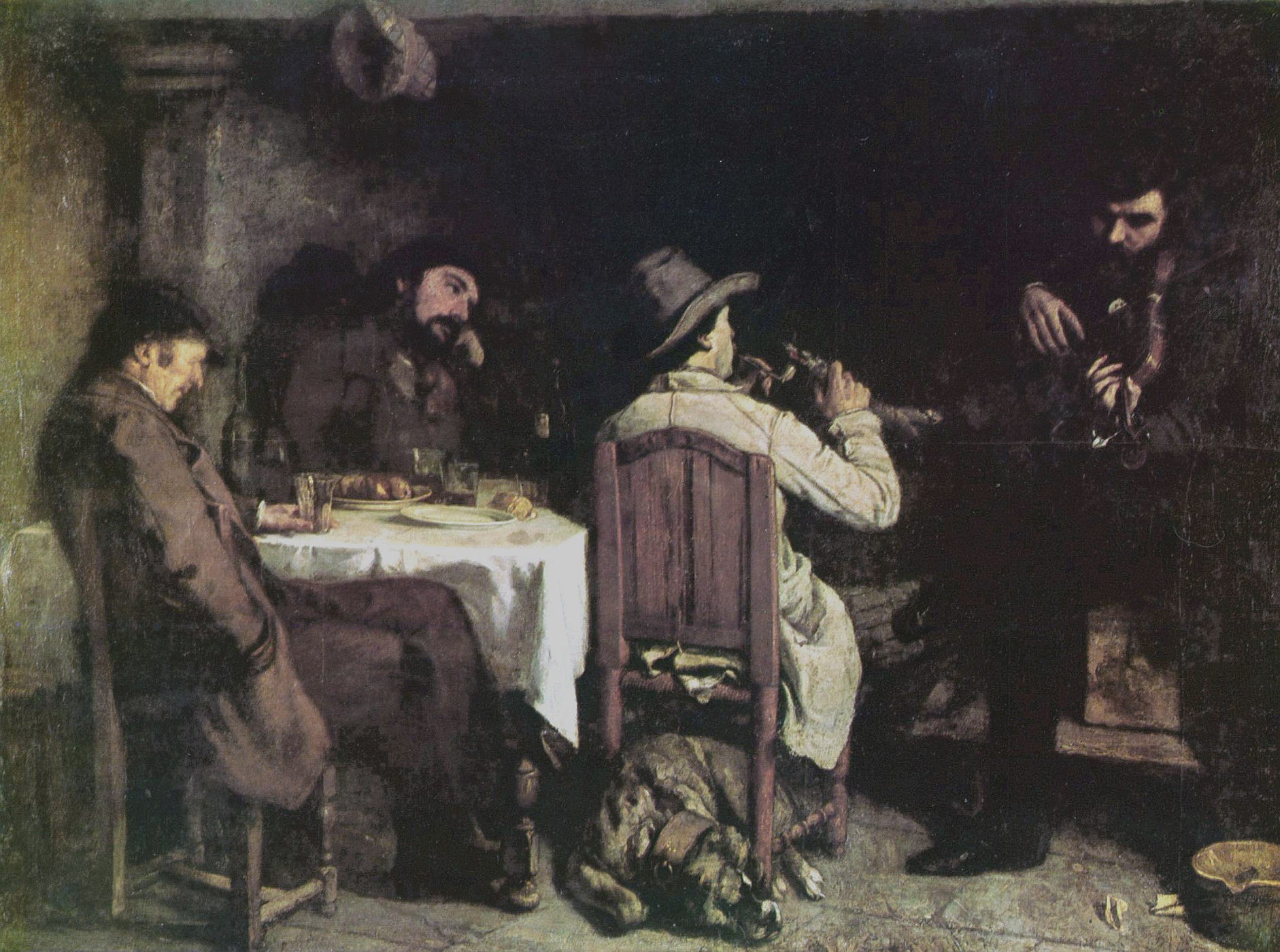
Courbet “After dinner at Ornans”, 1839
So, we pass in review a mindset that privileges appreciation about description. These examples are records of intrepid searching, charactaristically curious souls as eager for novelty as they are a hint of prowess or perfection. Their judgements are present-tense, fuel the discourse, encourage critique, suggest humor, and challenge staid themes.
I had another friend and wine buyer who was allergic to these new and exciting stories. He enjoyed ordering wines made by his friends, typically in the largest format available, at the deepest price breaks, and in record quantities. Our conversations inside and outside of professional tastings were only ever to do with wine, only since wine was made meaningful by the remarkable people who made the stuff. He’d descend upon the subject like a catholic theologian, speaking within the system of natural wine, its practitioners and its dogmas. Rich in fixed premises, this mountain of a man could systematize brilliantly. All existed within the context of a particular brain trust.
In just the same way that our aforementioned, tabula rasa empiricists tried to hip themselves to something completely unknown or without a history, this friend and wine buyer accepted all the concepts and players as axiomatic, which was a royal pain-in-the-a** for a wine salesman with new and exciting discoveries to pull out of his Herschel. If we weren’t tasting something recommended or following closely the project of Thierry Puzelat or Tom Lubbe, I was going to have a hard time.
As time has progressed, I appreciate more and more this approach. For starters, premise no.1 is a very good and easy premise to take up. It goes like, “For each middleman or salesperson downstream of the winemaker, every objective should be in service of garnering maximal material advantage to that vigneron.” What else could we be after? We want success for these farmers, such that God’s green Earth is more and more fostered by the hands that love it — those dedicated to its perpetuity. In my wine importer head, I internalize this premise like I’m the capitalist wing of this terrestrial enterprise and all of my salesmanliness is absolved.
Furthermore, this outlook generalizes beyond the world of natural wine. Parkerites, Italian Modernists, Steiner schüler and the rest all beget facsimiles of buyers like this. They support a set of principles and procedures over and above this bottle or that. These are the Rationalists a la Plato, Leibnitz and Descartes. Wines are ideas, crafted after and veridically tied to an intellectual ideal. Rudolf Trossen’s Riesling is an instantiation of the Steiner model. The buyer supports Trossen insofar as he upholds these principles, and as a collective movement with a common epistemic base, they build and enrich the idea.
Here you find wine buyers who don’t even drink; They don’t need to. They’ve done the research, know who to support, and taste merely to verify. Any that’s very cool! Sometimes these buyers buy wine just from emails. Wahoo!
They are remarkably proficient in modeling one wine in comparison to another. One gold-star example had me come and taste a brand new winery with wines from the first vintage. She was so struck by a haunting similarity to another winery she knew well. These were the wines of Les Cortis made in the Bugey. Still, they recalled so clearly to her the wines of Alice and Olivier De Moor. How, I still ask myself, could she have sensed that Jeremy Decoster of Les Cortis spent 10 years working with the De Moors? What was it that I couldn’t see?
These Rationalists champion winemakers and pledge loyalty to their intellectual compatriots. In that, I salut them. The tension for me comes with a particular economic consideration regarding the market that strikes me from time to time. The question is, which buyer affords the greatest economic equinimity for all parties involved?
This equinaminity could be pursued along three paths, in respect to the final consumer, in respect to the seller, and in respect to the farmer. We’ll consider each in turn, respective of the buyers we just examined.
-Affordability
Considering the price of a bottle of wine produced in an artisinal style, and the ratio it stands in to wages in the United States or in Europe, it is very difficult to argue that any of our efforts are working in service of the final consumer. Many of my natural wine collegues, particularly those in the older generation, still understand the modus operandi to be about affordability. How I wish this were so! Everyone should be able to partake in the miracle that is our career, but sadly we have priced them out. The working-class bar in your neighborhood is not serving natural wine, or any wine made by hand, and we all know why.
There is a sense in which natural wine offers value, as opposed to affordability. There’s a lot of beautiful wine out there, and it is priced like antique furniture. Why? Because it has terroir! It is typical and thus holds a consistent value over generations. They are honest grape ferments whose character has held up to the taste of both wide-eyed explorers and conservative collectors alike for many years. The natural wine movement took up many of the artisinal prescriptions of the most prized wines of the world (and pushed further), for a fraction of the price. To the chagrin of many, these wines displayed terroir cheaply, and a wretched generation like mine was able to leave the factory farm orbit for pennies on the Burgundian dollar.
The dream is that a combination of technology, intellect and a demand for quality will revolutionize agriculture and bring down the cost of production. Government subsidies will support what is of quality and meaning, and affordability will be something we can consider more acutely as buyers. For now, we need to incessantly taste wines made on the cheap that don’t necessarily fit all of our dogmatic principles, as well as find opportunities to expand are ridiculously limited pool of drinkers.
- Commerce
One thing I really like about our industry is the fact that a young person can come to a big American city without any higher education, learn a bit about wine, and earn a middle class income as a server or sommelier. Some of these folks can make quite a decent living, in fact. The 3-tier market allows for small businesses like mine, as well as a litany of small wine-shops in New York, where there are serious laws constraining big groups from owning multiple stores.
I toot my own horn in arguing that buyers ought to make considerations for these jobs in their buying. There is no reason, in our beautifully diverse ecosystem of alcohol production, to buy from a big corporation. There are hundreds of small portfolios supporting small farmers who make excellent wine, and the supply is huge. Young, burgeoning voices at wine bars and shops make their name discovering and championing these small estates, and a litany of small economies of scale are able to function this way. Buying in such a way that we approach each wine as something worthy of consideration is a great first step, but picking the thing that supports the right people doesn’t hurt either. In this day and age, with our wealth and abundance of good wine, it’s fun and easy.
- Production
I beat a dead horse when I advocate for the farmers who make our beloved wines. How can we work to further support the people who constantly make decisions in contrast to their economic benefit in service of beauty or ecological ethics? When they choose not to use a machine to harvest, when they choose not to use chemicals that kill the soil, when they choose to buy this or that container for elevage, they take the road less traveled, and our love for their product has to afford that gap in some way or another. Of course, this comes at odds to affordability and the possibility of a bigger, more consistent production.
The answer to all of this may be a genuine cop-out, but I suggest a kind of copernican turn in our thinking about buying. If we continue to regard wine as one, fixed and objective product, we’ll keep finding these antinomies in the economics, the aesthetics, or simply our enjoyment. The best buyers I know have absorbed all of these perspectives like tools at a workbench. Sometimes you buy the wine because it’s there and you can. Sometimes it’s just so good you can’t say no. Sometimes you have to support this or that winemaker, regardless of a trying vintage. Sometimes you just like the idea of buying this or that wine.
The best buyers know when to open these bottles, under what circumstances, and for which customers. There is an infinity of variables open to any shop worker, any floor somm, or any dinner guest that can contextualize any given wine. Just drink the wine is true, but it’s beholden upon the buyer to stop prejudging what’s in front of them at the tasting or in their inbox and figure out how and where such and such a wine can produce joy. Sometimes you need to tell a story, other times you need to pair it with the right dish. Mostly, you have to believe that wine is really about people, and that whatever bottle you select is a function for intrigue, joy, or whatever else you’ve projected onto the wine you bought. We so often have it backwards.
Is it relativism? Are all wines created equal? No, all wines have the potential to stand in a relation to two or more people such that an idea is generated or pleasure is shared. Some wines can beget an experience worth years of searching, but only for a few specific people. Some wines create a quotidian delight for millions. Sometimes those are the same wines. The point I’d like to make is that the content of the bottle, the taste of the wine, its quality, is a necessary but not sufficient condition for veracity. The thumbs up judgment needs also an attitude, context, and company that makes buying wine both really easy and really hard.
The hack for me, if I may be so annoying, is to look for what is good in a wine, not what bars it from perfection. IFF you can find joy in what you’re tasting, there will never be a problem selling it.
He always called it the “wine store,” which I liked for some reason.
Love this. You'll have to tell me what category of buyer I fall into. I particularly adore the finding the good in a wine, versus finding what's missing...a great concept to apply to things beyond wine. xo
Such a banger. But I wish you named some names!